
On this page
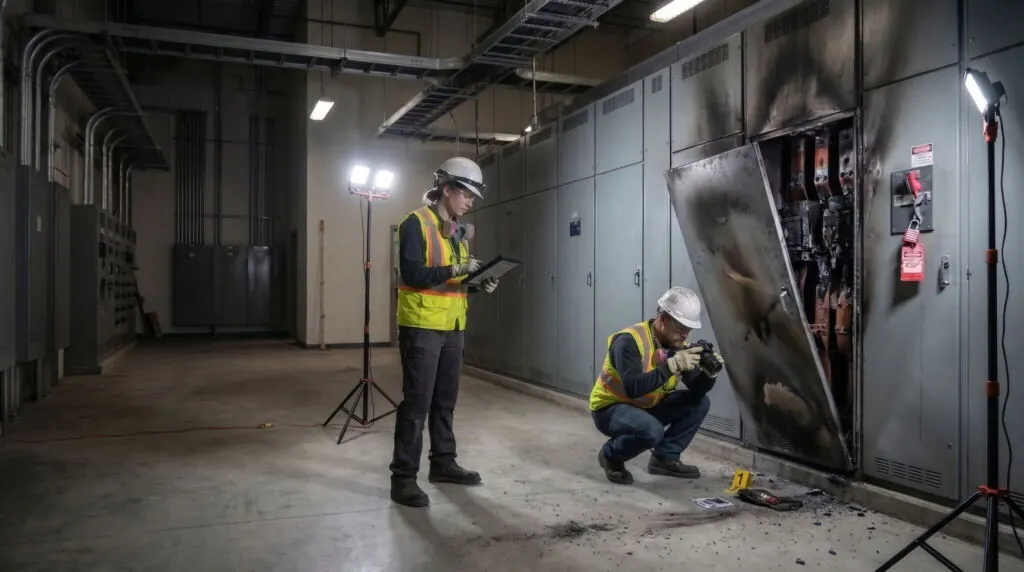
An arcing event takes a fraction of a second. The investigation that follows can take months, because the arc destroys much of what would explain it. What remains is burned-out equipment, a facility without power, and several parties who each have their own view of what happened.
This guide explains what an arcing event is, what it does to electrical equipment, where it happens, and why establishing its cause takes a forensic electrical engineer who understands the whole power system, not only the section that burned.
1. What is an arcing event?
An arcing event is an electrical fault in which current leaves its conductors and flows through the air: between phases, or from a phase to ground. The current turns the air into a conducting plasma, and the arc sustains itself until the protection interrupts it or the arc burns itself out.
Engineers distinguish an arcing fault from a bolted fault. In a bolted fault, the conductors are joined solidly and the fault current is as high as the system can deliver. In an arcing fault, the arc itself resists the current, so the fault current is lower. That difference matters: a protective device may see less current and take longer to operate, and the longer an arc burns, the more energy it releases.
Arcing events are also called arc faults or arc flash incidents, and arc blast events when the pressure wave does most of the damage.
2. Arc flash, arc blast and slow arcing
A high-energy arcing event releases its energy in several forms at once.
- Arc flash: intense heat and light. Arc temperatures are commonly cited at up to 19,000°C (35,000°F), several times the temperature of the sun’s surface. Copper and aluminium melt and vaporize, and nearby insulation burns.
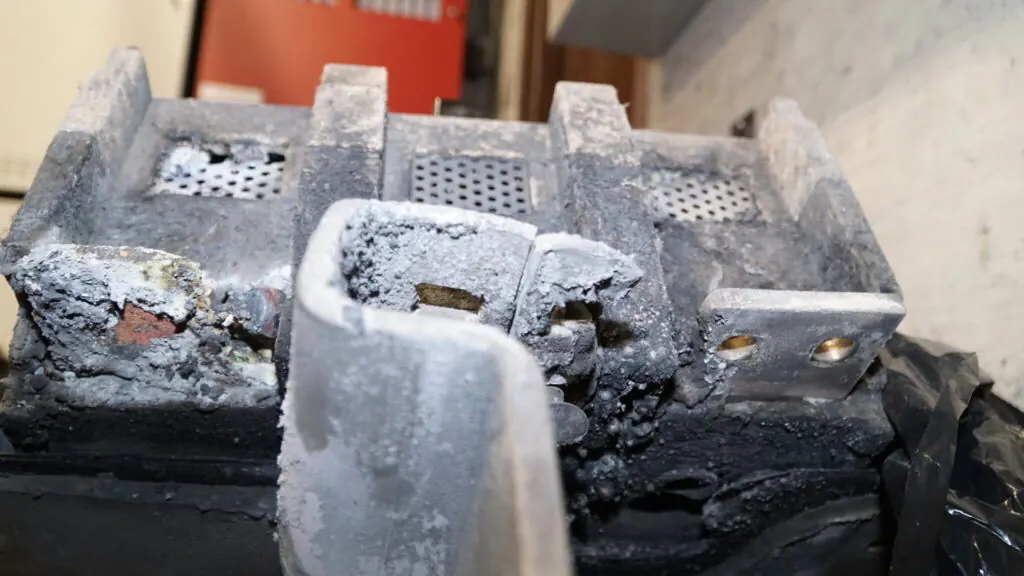
- Arc blast: vaporizing metal expands rapidly, producing a pressure wave and a loud report. It can throw molten metal and fragments, blow doors and covers off the equipment, and damage the room around it.
- Fire: burning insulation and nearby combustibles can carry the damage well beyond the equipment where the arc began.
Not every arcing event is a flash. Low-level arcing at a loose, overheated or degraded connection, or across a contaminated insulating surface, can continue unnoticed for a long time. It may never trip a breaker, and it can end as an electrical fire that leaves little sign of where it started.
Direct current systems, such as solar arrays and battery energy storage, add their own challenge: a DC arc has no natural current zero to help it extinguish, so it can be harder to interrupt.
3. Where arcing events happen
Arcing events occur wherever energized conductors sit close together and something weakens the insulation between them. Our electrical failure investigations cover arcing in:
- Low-, medium- and high-voltage switchgear and main distribution switchboards
- Panelboards, motor control centres (MCCs) and bus duct
- Circuit breakers, protective relays and their control systems
- Transformer and cable terminations and splices
- Solar PV systems, inverters and battery energy storage systems (BESS)
- Industrial and commercial equipment, lighting and appliances
4. Why the cause of an arcing event is hard to find
An arcing event is among the hardest electrical failures to investigate, for five reasons.
Many possible beginnings, one result
Insulation breakdown, a failing connection, contamination or moisture, a foreign object, an operating error, a protection failure: a catastrophic arcing event can begin in many ways, and the destruction it leaves makes them look alike. Pinpointing the true root cause takes analysis, never assumption.
The arc destroys its own evidence
The point where the fault began can be among the first things the arc consumes. An arc can also move once it forms, so the heaviest damage is not always where the fault started. Reading what remains takes experience with how arcing events develop.
The protection is part of the story
How long an arc burns, and how much it destroys, depends on how quickly the protection clears it. Why the breaker or relay did, or did not, operate as intended is the question at the centre of most switchgear claims. The answer can lie in the breaker, the relay, its settings, the trip circuit, control power or the coordination between devices, and often in more than one of them. That is why the relay record is often the most reliable witness to an electrical failure.
Many components, many systems
An arcing event rarely involves one component. The switchgear, its circuit breakers, the protective relays, the upstream supply and the loads downstream all play a part, and each has to be understood in relation to the others.
Every party has its own version
Manufacturers, installers, contractors, operators and utilities each see the failure from their side. The answer has to come from an engineer who answers to the evidence alone, and it has to hold up when insurers, counsel and courts test it.
5. The questions an arcing event investigation must answer
For an insurer, an adjuster or counsel, the burned equipment is where the file starts, not the answer. A defensible investigation has to establish:
- Where the fault began, and what initiated it
- Whether it was sudden, or the end of a condition that had been developing
- Why the protection cleared it when it did, or why it did not
- What allowed the damage to spread, and how far it reached
- The technical source the cause traces to: a product, its installation, its maintenance or its operation
Those answers are the independent technical foundation that coverage, recovery and subrogation decisions depend on. They have to be established from the evidence, by an engineer who can explain them clearly and defend them under scrutiny.
6. What to do after an arcing event
The first days after an arcing event decide what can be established later. Evidence lost then cannot be recovered.
- Keep people out until qualified personnel have made the equipment safe.
- Call a forensic engineer before anything is repaired, replaced, cleaned up or discarded.
- Keep the failed components, including parts that look undamaged.
- Keep the records: relay and event logs, single-line diagrams, protection coordination studies, maintenance history and the operators’ own accounts.
- Have the rest of the lineup cleared before it is re-energized.
- Tell the other parties with an interest, so the evidence can be examined jointly. Our guide covers how long evidence must be kept after a forensic investigation.
7. How MCF investigates arcing events
Mission Critical Forensics (MCF) is a team of experienced forensic experts specializing in switchgear, electrical power systems and protection and control (P&C). Our investigations have included catastrophic arc flash events at main electrical distribution switchboards, and our electrical failure work covers arcing incidents, electrical fires and electrical explosions in low-, medium- and high-voltage systems.
Our approach is systemic. In every switchgear failure investigation, we look at the entire power system around the failure, not only the section that burned, and establish where the fault began, how it developed, why the protection did or did not stop it, and the technical source it traces to.
Our findings are independent and based solely on evidence, and our reports are written to be clear, concise and defensible. When a matter goes further, our engineers serve as expert witnesses.
Frequently asked questions
What is the difference between an arc flash and an arc blast?
They are two effects of the same event. The arc flash is the heat and light of the arc. The arc blast is the pressure wave created as metal vaporizes and the air around the arc heats and expands, throwing molten metal and fragments. A high-energy arcing event produces both.
What is the difference between an arcing fault and a bolted fault?
In a bolted fault, the conductors are joined solidly and the fault current is as high as the system can deliver. In an arcing fault, the current flows through an arc in the air, which resists it, so the current is lower. A lower current can mean slower protection and a longer-burning arc.
Can arcing cause an electrical fire?
Yes. High-energy arcing can ignite insulation and nearby combustibles at once, and low-level arcing at a loose or degraded connection can continue unnoticed until it starts a fire. Whether arcing caused a fire or was caused by it is a forensic question in its own right.
Who investigates an arc flash incident?
A forensic electrical engineer with switchgear and protection and control expertise. Mission Critical Forensics (MCF) investigates arc flash and arc blast incidents across Canada, from main distribution switchboards to medium-voltage switchgear, and establishes where the fault began, how it developed, and why the protection did or did not stop it.
Should damaged equipment be repaired before the investigation?
No. Call a forensic engineer as soon as the event happens, and before the equipment is repaired, replaced or cleaned up. Evidence lost in the first days cannot be recovered, and it often decides the claim.
Who do you work for?
Insurers and adjusters, subrogation and defence counsel, utilities, and the owners and operators of industrial, commercial and data centre facilities.
Have a complex loss to investigate?
Contact Mission Critical Forensics to discuss the file.
Submit an assignmentRelated Posts
One Solar Plant Outage, Three Different Root Causes.
Why root cause requires power systems, protection, and apparatus expertise — reviewed together, not handed off.
Read More »
What DGA Doesn’t Tell You
Dissolved Gas Analysis tells you a transformer has a fault. It will not tell you where it started, when, what…
Read More »
Capacitor Bank Failure: Why the Obvious Cause Is Usually Wrong
A power-factor correction capacitor bank ruptures and takes part of a facility offline. The obvious cause — a worn-out capacitor…
Read More »