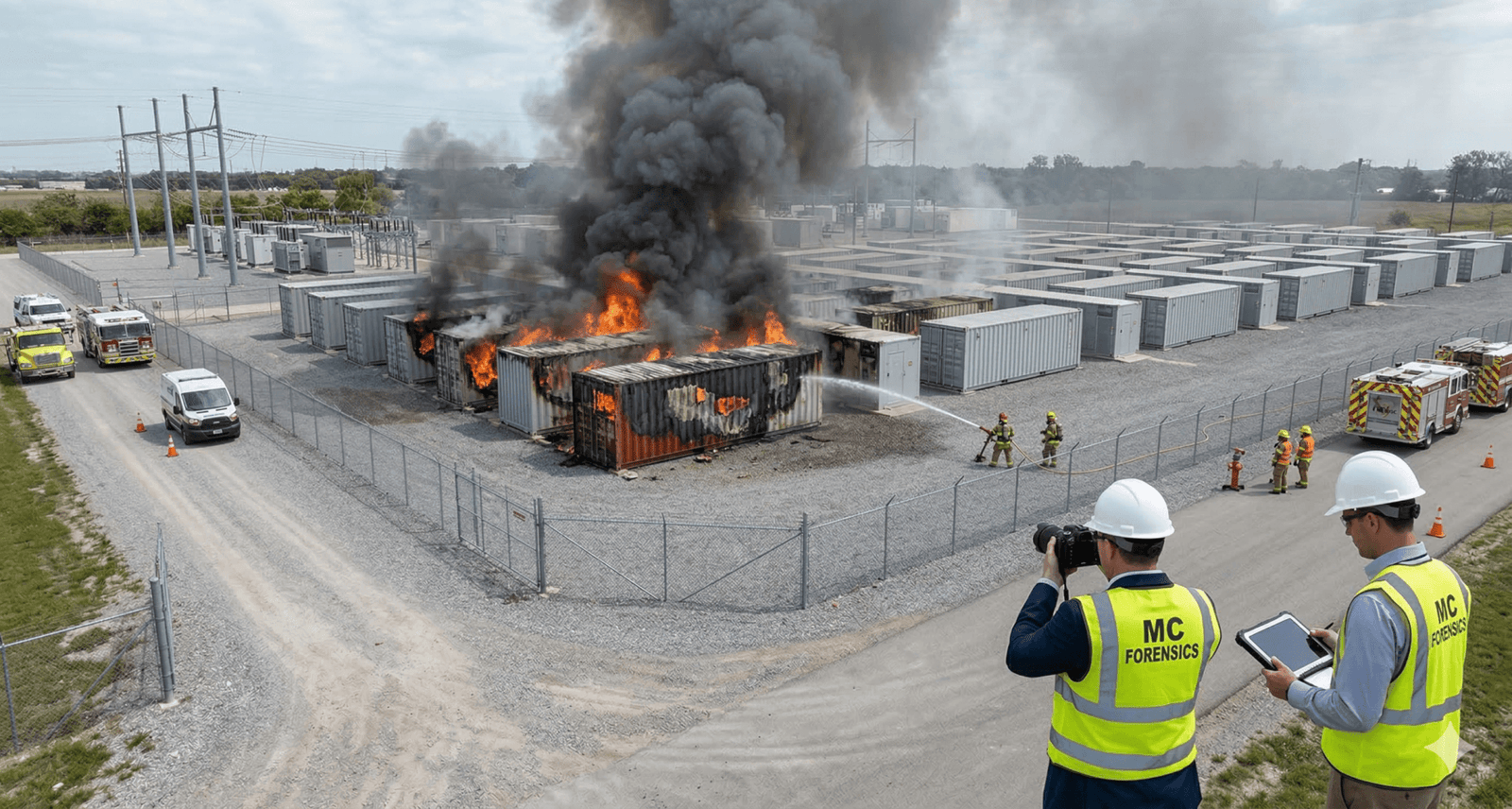
Mission Critical Forensics provides specialist BESS fire investigation and explosion forensics across Ontario, delivering evidence-based origin and cause determinations built for insurance claims, subrogation proceedings, and litigation. All investigations are led by our Principal Engineer, Alicia Yan P.Eng. CFEI.
When a Battery Energy Storage System (BESS) catches fire, explodes, or sustains a catastrophic loss, the investigation that follows is unlike any other. The physical evidence is chemically transformed. The failure sequence spans multiple interacting systems. The liability picture involves a chain of parties — cell manufacturers, system integrators, BMS vendors, installation contractors, and operators — each with competing technical narratives. Standard fire investigation methodology is not built for battery storage losses.
A BESS fire is one of the most technically demanding losses in the commercial property and energy insurance market. Fire damage in a battery storage facility destroys physical evidence, compromises operational data, and leaves behind a scene that requires specialist methodology to read correctly. We determine the origin and cause of BESS fires — establishing where the fire began, how it spread through the battery modules, racks, and enclosure, and which systems failed to detect or contain it. Our findings are documented to the evidentiary standard required for insurance claims, subrogation actions, and litigation.
BESS explosions present a distinct investigative challenge from fires. There are two physically different explosion types that occur in battery storage facilities, each with different signatures in the evidence, different failure mechanisms, and different liability implications. Correctly identifying and distinguishing between them is a foundational step that shapes every aspect of the investigation that follows.
Not every BESS loss event is a total fire. Partial losses — equipment damage confined to specific modules, racks, or subsystems — are often more difficult to investigate than total loss events, because the surviving evidence must be read carefully against a complex operational and physical backdrop. We investigate partial loss and equipment damage events where the cause is contested, where coverage is in dispute, or where subrogation recovery is being evaluated.
BESS facilities that experience unexpected shutdowns, repeated protective trips, or significant output degradation without a clear precipitating event constitute a category of loss in which the technical narrative is almost always contested among the operator, equipment suppliers, and the installer. We provide independent forensic investigation of contested shutdown and performance loss events, establishing the sequence of events and the system or component at the origin of the loss.
A major BESS fire does not confine its consequences to the battery enclosure. Toxic gas release, heavy metal contamination, firefighting water runoff, and structural damage to adjacent property constitute a category of loss that extends well beyond the cost of equipment replacement. We support investigations involving environmental harm, third-party property damage, or personal injury claims arising from a battery storage fire or explosion.
BESS claims sit at the intersection of property, equipment breakdown, and environmental liability. Loss quantum in a utility-scale battery storage fire routinely runs into the tens of millions — before business interruption, environmental remediation, and third-party exposure are considered. We provide the specialist technical investigation that underpins coverage determination, quantum scoping, and subrogation evaluation.
BESS fire and explosion litigation demands expert witnesses who can give technically defensible opinions across battery system failures, electrical engineering, fire science, and code compliance. Our Principal Engineer provides expert witness testimony and prepares reports structured to withstand adversarial technical scrutiny.
Battery storage losses frequently involve recoverable third-party liability. We identify and preserve technical evidence supporting a recovery position and structure our root cause analyses to meet the evidentiary requirements of subrogation proceedings.
After a loss, operators need an independent technical assessment before they can file a claim, engage with regulators, or make credible decisions about rebuilding or restarting. We provide post-incident investigation that is independent of the equipment vendors and contractors whose interests may not align with the operator’s.
Immediately. Physical evidence in a battery storage fire degrades rapidly, and operational data records can be overwritten. Early engagement determines what evidence is preserved and what questions can ultimately be answered.
Key standards include NFPA 855, UL 9540A, IEC 62619, IEC 63056, and the Canadian Electrical Code (CSA C22.1). Our investigations include a systematic compliance review — departures from applicable standards are frequently significant contributors to losses and the liability picture.
We investigate utility-scale grid-connected BESS, commercial and industrial battery storage systems, and co-located solar-plus-storage and wind-plus-storage facilities. We work across all major lithium-ion chemistries including lithium iron phosphate (LFP) and nickel-manganese-cobalt (NMC), and across containerised outdoor and indoor rack installations.
Yes. Our root cause analysis reports are prepared to serve insurance claims, subrogation actions, and litigation. Our Principal Engineer is available to provide expert witness testimony.
Our team provides expert investigation and analysis for BESS fires & explosions, offering distinct advantages:
Specialist discipline: Battery storage fire investigation requires integrated expertise across battery system failures, electrical systems, fire science, and energy storage codes and standards. We do not apply general fire investigation methodology to BESS losses.
Evidence-first methodology: Investigations follow NFPA 921 principles, adapted for the specific physical and chemical characteristics of battery fire scenes. Conclusions follow evidence.
Early engagement capability: We mobilise quickly to active loss scenes. Time is a critical variable in every BESS investigation.
Built for claims and litigation: Reports are structured for insurance proceedings, subrogation actions, and expert cross-examination.
Independent: We are retained as independent investigators. Our findings reflect the evidence, not the preferred narrative of any interested party.
Investigating a BESS Fire or Explosion? Contact our Principal Engineer directly to discuss your assignment.
Get the precise assessment and engineered path to restoration
Our forensic engineering team provides professional analysis and expert testimony to strengthen your case. Don’t navigate complex technical evidence alone. Call Us Today (416) 900 6066
Get the latest insights and updates — sign up for our newsletter!